
The wellness world is full of sound-based products, services, and claims. Some are well-supported. Many are marketing. Telling the difference is a useful skill for anyone who wants to make informed choices about their time, money, and health.
This is a practical framework.
The basic test
For any claim about a sound-based practice, ask:
- Who is making the claim? A peer-reviewed research paper, a licensed clinician, an institution like the NIH — or someone selling you a product?
- What is the specific evidence? “Studies show…” without naming studies is not evidence. Specific citations you can look up are.
- How strong is the claim? “Relaxing” is a modest claim with broad support. “Cures anxiety” is a strong claim that requires strong evidence.
- What does the claim depend on? A practice that works only if you pay $497 for a specific “certified” product is more suspicious than one that works with equipment you already have.
This won’t always produce a clean yes/no answer, but it will help you separate defensible claims from marketing.
Green flags — claims that tend to be well-supported
“Calming music can support relaxation.” Supported broadly by research on music and the autonomic nervous system.
“A consistent evening routine can support sleep onset.” Supported by sleep research across many interventions, including audio ones.
“Music therapy, delivered by a credentialed music therapist, can support patients in specific clinical contexts.” Well-established professionally and supported by research.
“Listening to familiar music can be meaningful for people with dementia.” Well-documented, including through programs like Music & Memory.
“Sound-based practices can complement meditation.” A reasonable framing that doesn’t overclaim.
These kinds of claims tend to be defensible. They are also modest — which is part of why they’re defensible.
Yellow flags — claims that require scrutiny
“Studies show…” without specific citations. Who did the study? Where was it published? How many participants? What effect size? Without these details, “studies show” is rhetorical, not evidentiary.
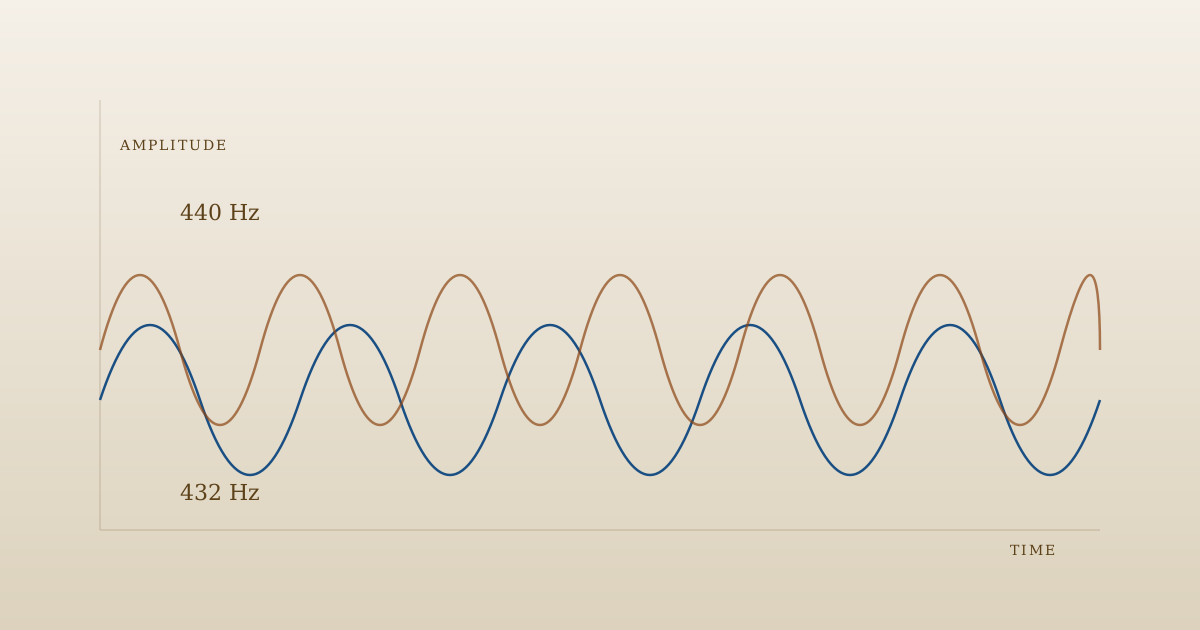
“This frequency is scientifically proven to…” Specific frequency-to-outcome claims rarely survive peer review. Treat them skeptically.
“Ancient wisdom confirmed by modern science…” Usually neither genuinely ancient nor confirmed by modern science. Often a marketing combination.
Before-and-after testimonials as the main evidence. Individual testimonials don’t establish general effects. A marketing site full of testimonials and no other evidence is a marketing site.
“Doctors are stunned by this simple trick…” Virtually always clickbait marketing, regardless of topic.
Red flags — claims to walk away from
Specific medical cures. “Cures cancer,” “reverses Alzheimer’s,” “eliminates tinnitus forever.” Sound-based practices cannot do these things. Anyone claiming otherwise is either mistaken or being dishonest.
DNA / cellular / quantum claims. “Reshapes DNA at the quantum level” and similar phrasing is marketing language that misuses scientific terms. Not supported by any credible research.
Expensive required products or certifications. If the “healing” requires you to buy a $3000 specialized tool from one specific vendor, the economic incentive is doing most of the claiming.
Pressure to commit to packages. “Buy the six-session package today for the discount.” Reputable practitioners let you try one session first.
Urgency and scarcity marketing. “Only 3 spots left!” “Special offer expires tonight!” is marketing, not medicine.
What reputable institutions say
For general guidance on evaluating wellness claims, the NIH’s National Center for Complementary and Integrative Health maintains consumer-focused resources on how to think critically about complementary health practices. [VERIFY: confirm NCCIH consumer guidance page.]
The NCCIH also publishes guidance on the different categories of complementary approaches and how they relate to conventional medicine. [VERIFY.]
These are good starting points when you are trying to sort marketing from substance.
A note on personal experience
None of this is an argument against personal experiences. If you have tried a sound-based practice and find it meaningful, that experience is real. You don’t need to justify it with research.
The question this article addresses is different: when is a claim about sound healing reliable enough to act on — especially when money, time, or health decisions are involved?
Personal experience is a reasonable basis for personal practice. It is not a reasonable basis for specific medical claims made to other people. Those require more.
A practical consumer summary
When evaluating a sound-based product, service, or claim:
- Take modest claims seriously. Calming, supportive, complementary, relaxing — these are defensible.
- Question strong claims proportionally. Healing, curing, reversing, transforming — these require strong evidence.
- Favor sources with nothing to sell. Government agencies, university medical centers, peer-reviewed research.
- Be skeptical of sources that make money from the claim. Marketing is marketing, even when it’s wellness marketing.
- Trust your own experience for your own practice. Just don’t confuse it with evidence of general effects.
This approach won’t make you cynical. It will make you discerning — which is what the wellness market, with its mix of genuine benefit and heavy marketing, actually requires.
Common reader questions
Does 'no scientific evidence' mean something is fake?
Not necessarily. Some practices have limited research because they are hard to study, not because they don't work. But for claims about specific medical outcomes, absence of evidence should lead you to approach those claims with appropriate skepticism — especially when they are being sold to you.
What about personal testimonials?
Testimonials are meaningful to the person describing them, but they are not the same as evidence of effects in general. People often experience benefit from practices that don't produce measurable effects in controlled research — often through placebo, routine, ritual, or expectation. That doesn't make the personal benefit unreal; it just means testimonials can't tell us what causes the benefit.
How do I find reliable information?
Look to institutional sources: NIH (especially the NCCIH), university medical centers, peer-reviewed research, and reputable journalism. Be cautious of sources that are selling the thing they're describing, sources that cite only unnamed studies, and sources that make very specific medical claims without supporting evidence.